Showing posts with label Healthcare news. Show all posts

Tuesday, October 28, 2014

Healthcare Headlines, Part 2


By Rick Fromme

Photo Credit: naturalnews.com
Welcome back to our second edition of “Healthcare Headlines.” In a popular blog that was posted in late August (“Viruses, Bacteria and Headlines, Oh My!”), I had cited several international Ebola experts on Ebola who claimed that in their estimation, Ebola wouldn’t become a major issue in the U.S.:
“However, the CDC and other leading experts are virtually unanimous in emphasizing the likelihood of Ebola spreading like wildfire across the U.S. is very low. And if a developed country such as the U.S. should experience some isolated cases, our healthcare system has the wherewithal to deal with and contain the infection (in its current state).” 

While to date, less than a handful of people in the U.S. have tested positive for Ebola, it remains to be seen if these experts’ prognostications will come to fruition (let’s hope so!)  But Ebola is one of the key health issues making headlines right now, so I thought I would post some of the most recent news items concerning the disease. 

New Ebola Study Finds it’s Best to Screen Outbound Flights 
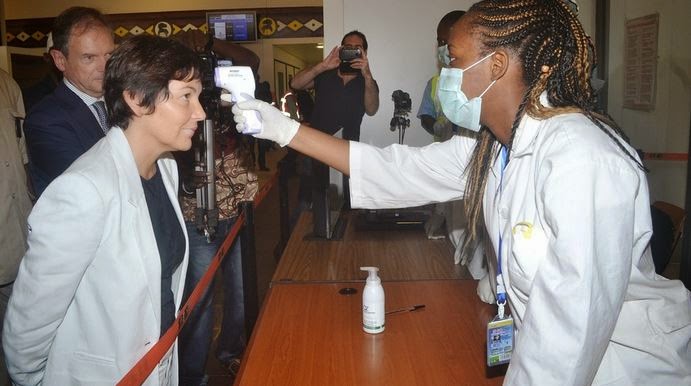
 

Photo Credit: marketwatch.com
Given the current rates of infection of the Ebola virus infection found in Liberia, Sierra Leone and Guinea, a team of Canadian infectious disease specialists estimates that as many as three passengers each month are likely to travel on international flights departing from one of the above African countries where the disease continues to proliferate.

As was published in the “The Lancet,” just this past Monday, the research concludes that screening airline travelers in order to block the virus' export would be far more effective if screening tests were conducted at airports inside the three stricken countries, rather than screening done in arrival countries such as the U.S.  

The analysis suggests that on average, every 10.5 days, a single person infected with Ebola is likely to carry the virus by air from Liberia, Sierra Leone or Guinea to another country.

For public health officials considering the best protocol to stop passengers who could be exporting the Ebola virus, that pattern of international travel tilts the screening calculation vastly in favor of doing so at airports in those above-mentioned countries. 

Photo Credit: wibwnewsnow.com
Every international airline passenger screened at one of those three countries’ airports could be a carrier of the
deadly virus, the authors of the “Lancet” analysis assumed. Airports throughout the U.S. and other countries that aren’t permitting any direct flights from Liberia, Sierra Leone or Guinea. However, thermometer-wielding personnel would have to screen 2,512 passengers in order to find one who may have been exposed to Ebola.

In more disheartening news, the study suggests that countries that are presently the least able to manage the arrival of passengers are also most likely to receive infected passengers. Of those expected to travel internationally from the three West African countries affected by Ebola in 2014, more than 60% are likely to have final destinations in low- or lower-middle-income countries such as Ghana and Senegal.

Moreover, says study coauthor, Dr. Isaac I. Bogoch, screening passengers for Ebola symptoms such as fever will likely miss about 90% of those infected, since the virus' incubation is widely thought to be about 10 days, with the maximum incubation period of 21 days.  For as many as nine days (in some cases, longer), an infected person would likely show no signs of fever, limiting the value of thermal screening.

GOP Leaders Say New Ebola Restrictions Don’t Go Far Enough


Photo Credit: redflagnews.com
In a related Ebola-oriented news item, last week, several GOP leaders said the Obama administration’s new Ebola restrictions don’t go far enough and are pressing for a full travel ban. The leaders of three House committees renewed calls for President Obama to suspend U.S. visas for anyone traveling from Liberia, Sierra Leone and Guinea, where more than 4,500 people have died from Ebola.

CDC Tightens Rules on Caring for Ebola Patients


As of today, four people have been officially diagnosed with Ebola in the U.S. (The young  boy in NYC who was thought to possibly infected tested negative for Ebola.) As stated on the Center for Disease Control's website, Cases of Ebola Diagnosed in the United States:

"CDC confirmed on September 30, 2014, the first laboratory-confirmed case of Ebola to be diagnosed in the United States in a man who had traveled to Dallas, Texas from Liberia. He did not have symptoms when leaving Liberia, but developed symptoms approximately four days after arriving in the United States.

Photo Credit: premiumgist.com
"The man sought medical care at Texas Presbyterian Hospital of Dallas after developing symptoms consistent with Ebola. The index patient passed away on October 8.

"On October 10, a healthcare worker at Texas Presbyterian Hospital who provided care for the index patient tested positive for Ebola. The patient has since recovered and was discharged on October 24.

"On October 15, a second healthcare worker who provided care for the index patient at Texas Presbyterian Hospital tested positive for Ebola. The second healthcare worker had traveled by air October 13, the day before reporting symptoms. All passengers and crew on the two flights (Dallas to Cleveland on October 10, and Cleveland to Dallas on October 13) have since been contacted by public health professionals and are being monitored.

"On October 23, the New York City Department of Health and Mental Hygiene reported a case of Ebola in a medical aid worker who had returned to New York City from Guinea, where the medical aid worker had served with Doctors Without Borders."

Photo Credit: latimes.com
Given the mishandling of the first patient in Texas, now, full body suits and respirators are being recommended, along with a monitor to observe workers when removing their gear.

Last Monday, U.S. health officials officially tightened guidelines for health workers treating Ebola patients, now requiring full body suits with no skin exposure and use of a full-time respirator. 

The U.S. Centers for Disease Control and Prevention (CDC) decided to issue the tougher rules after two Dallas nurses contracted Ebola while caring for the first patient diagnosed in the U.S., a Liberian national who was visiting in Texas. The first patient and procedures were in September. The two nurses were following Ebola guidelines that the CDC first issued in 2008 and had updated during the summer. However they ended up contracting the disease but have since recovered. The CDC now recommends a very specific set of gear to be worn by healthcare workers treating Ebola patients:

  • Double gloves
  • Waterproof boot covers that go to at least mid-calf
  • Single-use waterproof or water-resistant gowns that extend to mid-calf
  • Disposable, single-use, full-face shields
  • Surgical hoods to ensure complete coverage of the head and neck
  • Waterproof apron that covers the torso down to the mid-calf if the patient is vomiting or experiencing diarrhea
  • Use of a respirator at all times ― either an N95 respirator or a powered air purifying respirator
  • Healthcare workers must undergo rigorous and repeated training in donning and doffing all this gear, until it becomes "ritualized," the CDC emphasized.

A Breathalyzer to Detect Hospital-Acquired Infections


Photo Credit: gizmag.com
The startup firm Isomark, in Wisconsin has developed a breath-based test that can detect infection within two hours of its onset. The patented concept has wide-reaching applications ― for instance, developing a smart neonatal incubator that’s constantly checking a preemie’s breath for signs of sepsis.

The company received $2.2 million in NIH-backed SBIR grants; the device is in the midst of a 110-patient trial at the University of Wisconsin. 

The general idea, however, is that  by using the non-invasive measurement of breath-based biomarkers, patients could be diagnosed and treated much quicker than if they wait for a lab results of, say, a blood test. The uses for Isomark’s test include initial disease detection in a clinic and other outpatient medical services, and importantly, post-op monitoring of patients who are at risk of contracting hospital-acquired infections such as sepsis and MRSA. Sepsis is a major problem in ICUs; the NIH estimates that 28-50% of the 750,000 Americans who develop it each year die.


Paralyzed Man Walks Again After Nose Cells Repair His Spinal Cord

Photo Credit: techtimes.com
A 40-year-old paralyzed man from Poland can now walk again (with the aid of a frame) after breakthroughsurgery transplanted cells from his nose into his spinal cord, which had been severed in a knife attack.

The innovative procedure effectively provided a "bridge" over the injury site so nerve cells ― encouraged by the special nose cells ― could regrow across the scar tissue in his spinal cord.

The patient was left paralyzed from the chest down after suffering stab wounds to his back in 2010.  After 19 months of treatment at a Polish hospital, his doctors say he’s recovered some voluntary movement patterns and has now regained some sensation in his legs.

The patient is continuing to improve further than predicted; he’s now able to drive and live more independently.
 

Vaccinations “Not Linked to Increased Risk of MS, CNS Disorders”


Photo Credit: mysuncoast.com
Contracting some findings suggest in previous research studies, a new study published in “JAMA Neurology”
didn’t correlate the association.

In this latest study, researchers set out to assess the link between vaccinations and MS and other Central Nervous System (CNS) disorders in more detail.

The researchers said they found no link between any vaccines ― including HPV vaccines and hepatitis B vaccines ― and an increased risk of MS or any other central nervous system disorder up to three years following vaccination.

However, they did find a link between vaccines and increased risk of CNS disorders among younger patients within the first 30 days after vaccination, but the association disappeared after 30 days. The researchers say this indicates that "at most, vaccines are redundant enhancers of pre-existing autoimmunity."


Health Tip: Dish Up Healthier Halloween Goodies


Young trick-or-treaters typically are overloaded with sugar-loaded candy, but that doesn’t mean you have to contribute to their soaring sugar levels. The Academy of Nutrition and Dietetics suggests these healthier Halloween options:

Photo Credit: lindawagner.net
  • Vitamin C-packed, 100%-fruit chews
  • Trans fat-free animal crackers or some sugar-free gum
  • Small juice boxes with 100% fruit juice
  • Small cups of low-fat pudding
  • Halloween stickers, temporary tattoos, pencils or other non-food goodies.

In this second edition of “Healthcare Headlines,” I focused on some of the most current breaking news stories concerning Ebola. The first article cited a recently published study that suggests airport screening should be done in the countries that are experiencing the Ebola epidemic. I mentioned that GOP leaders want to see stronger restrictions set forth by the current administration. The third Ebola-oriented segment focused on the CDC’s new guidelines for healthcare workers treating Ebola patients pertaining to protective clothing. I also featured summaries of other recent medical news articles such as the development of a new breathalyzer that can sense the early onset of various infections, new advances in spinal cord surgery and repair, a new study that found no causal effect of vaccinations and CNS disorders and MS, and lastly, some healthy alternatives to sugar-laden candy for Halloween.

If you found this article useful, please feel free to click “Like” as well as share and repost it. If you have any questions or comments, as always, I’m eager to read them.

Rick Fromme combines entrepreneurial enthusiasm with an insider's knowledge of the medical industry to co-found MedMasters.com. Both his drive and perspective helps provide health care professionals with a superior mechanism with which to communicate, network and market their strengths. Prior to founding MedMasters.com, Rick operated a highly successful medical device distributorship. Other milestones in his 12-year career in the medical industry include a key position at a medical device start-up company that was later sold to the Ethicon Endo division of Johnson & Johnson. You may also reach Rick by connecting with him on FacebookTwitterGoogle+LinkedIn and YouTube

Wednesday, September 24, 2014

Healthcare Headlines, Part 1


By Rick Fromme

Photo credit: digitalworksconsulting.com
By its very nature, healthcare has always been a perpetually changing profession. Advances in research, clinical procedures, infection control, new devices and drugs, plus an array of governmental and administrative policies all demand that clinical and administrative personnel be flexible, educable and mentally pliant. 

It seems like nearly every day, there’s a new study. A new device. A new procedure. A new law. A new policy. 

Given healthcare’s dynamism, its inherent propensity for change, and sometimes paradigm-shifting information, I thought I’d feature an ongoing blog series entitled “Healthcare Headlines,” which will address some of the newest, most up-to-date stories and news items pertaining to our field. 

  
As many of you know, throughout two of our ongoing blog series, we’ve been featuring some of healthcare’s newest, most innovative technological devices and advances worldwide — covering such breakthrough innovations as the ReWalk, 3D organ printing, nanotechnology robots, non-invasive skin closures, etc.(See “FascinatingCaptain!” and “The Land of Milk & Honey and Med Tech Boom.”) 

And, of course, over the past few decades Healthcare IT (HIT) has been improving the practice and delivery of medicine via technology as well. In case you hadn't heard, last week, September 15-19, was National IT Health Week (NHIT Week).

Photo credit: blogs.scientificamerican.com
One of HIT’s main areas of concern pertains to Electronic Health Records (EHRs), which have been shown to improve the delivery of healthcare, enhance patient safety, diminish medical errors, and improve the interaction between healthcare providers and patients. (See our previous blog  A Look Inside Healthcare IT Jobs.”)    
     
During NHIT Week, one of the major reports that was published dealt with how individuals are accessing and utilizing their EHRs. The report, entitled, Individuals’Access and Use of their Online Medical Record Nationwide showed that while the general public is taking advantage of EHRs, there is still room for improvement. 

“The ability of individuals to access and use their online medical records serves as one of the cornerstones of national efforts to increase patient engagement and improve health outcomes,” the report states from the outset. Some of its key findings:  

When seeking care for a medical problem within the last year, about one in three individuals experienced gaps in information exchange. Common gaps included patients having to recount their medical history because a healthcare provider had not received records from another provider or having to bring test results to an appointment. 

The report also found: 
  •  Almost three in 10 individuals were offered access to an online medical record.
  • Among those who were individuals given access to the online medical record, almost half were provided access by only their health care provider; and another four in ten individuals were given access by both their health insurer and health care provider.
Photo credit: executivegov.com
  • Less than one in ten individuals were given access to their online medical record by only their health insurer
Furthermore, the report showed that individuals who accessed their online record used it for a variety of purposes:
  • To monitor their health
  • To share information with someone else such as another healthcare provider or family member
  • Nearly half downloaded the information to their PC or a storage device
  • 1 in 10 forwarded the information to use as an app or Personal Health Record (PHR)
  • 1 in 10 requested that errors contained within their EHR to be corrected. 

New Study Recommends Lifting Ban on Blood Donations from Gay Men 


Photo credit: www.abc.net.au
No doubt about it, this news item is generating lots of discussion. 

According to a new study by the Williams Institute at UCLA, if the FDA were to lift its current ban on gay men donating blood, hundreds of thousands of pints would be available every year for patients in need of transfusions, which in turn could save millions of lives each year.If the ban were lifted in the U.S., approximately 615,300 pints of blood would become available every year. Currently, the UK permits gay men to donate blood if they haven’t had a sexual partner in a year.  If donations were limited to gay men who haven’t had sex within a year, some 317,000 pints of blood would be available. Canada’s policy current stipulates five years of abstinence.  Enacting Canada’s five-year policy would yield in an extra 300,000 pints.

The American Red Cross suggests that each blood donation has the potential to be used in life-saving procedures on three individuals,” said the study’s co-author Ayako Miyashita.  “Our estimates suggest that lifting the blood donation ban … could be used to help save the lives of more than 1.8 million people.”

The American Medical Association, the American Red Cross, and the American Association of Blood Banks, have all called on the FDA to end its ban, describing it as “discriminatory and not based on sound science.”

An FDA spokeswoman stated the agency would continue to re-evaluate its policies, but it currently has no plans to ease the ban until further studies indicate that patients receiving transfusions won’t be at an increased risk.

The FDA enacted its ban back in 1983, after discovering HIV was being transmitted through blood transfusions. But that was during the HIV/AIDS epidemic, and since then mainstream behavior and understanding has changed significantly.

Wearing Google Glass Shown to Benefit Surgeons’ Response Time 


Photo credit: rte.ie
You may have heard some of the stories about people who were found to be wearing Google Glass in public where at the very least they had been challenged by others for invading their privacy. Some depicted incidences where Google Glass wearers were physically accosted. 

Turns out that while some may not approve or enjoy Google Glassers recording their every public move, the new device is making a positive name for itself in healthcare. 

Patient care, particularly through the use of EHRs (as stated above) is data-driven. However, physicians, particularly surgeons, need a way to receive and manipulate data while remaining hands-on with patients. Enter Google Glass. 

A recent joint study was conducted by Stanford Medical School and VitalMedicals that analyzed surgeons' response time during various procedures. The study sought to determine if Google Glass in the OR could improve clinical outcomes. A group of 20 Stanford residents performed two types of routine surgeries on dummies, one group wearing Google Glass, the other without. 

The experiment was programed so that during the mock operation, a sudden complication would occur, which required the residents to perform an urgent procedure on "the patient."

The result? Residents who used Google Glass during the procedure performed measurably better. 

One test had the residents perform a bronchoscopy, whereby the surgeon makes an incision in the patient’s throat to access a blocked airway. The surgeon might also insert a camera into the lungs to locate issues. In this control group, the residents using Google Glass/VitalStream software recognized critical desaturation 8.8 seconds faster than the control group (which didn’t wear the glasses). 

Photo credit: ubergizmo.com
In another test, the patient required a thoracostomy tube placement through the chest wall to drain fluids. Here, the residents using Google Glass/VitalStream software recognized hypotension in the patient 10.5 seconds sooner than the control group.

The residents wearing Google Glass didn’t need to look up at the monitoring equipment as frequently, thereby allowing them to be more focused on "the patient" during the operation. The preliminary evidence of the study indicates that Google Glass’ head-mounted display can be used in clinical settings to enhance surgeon response time and patient safety.


Hands-free Vital Sign Monitoring on Google Glass

In this first segment of “Healthcare Headlines,” I explained why, given healthcare’s constantly changing nature, I decided to create this series. I went on to feature three recent and significant news stories. The first highlighted findings from a key report issued during last week’s National Healthcare IT Week convention.  The second segment discussed how several major healthcare organizations are requesting the FDA terminate its ban prohibiting gay men’s blood for transfusions. The third segment highlighted a recent study that found surgeons using Google Glass in the OR were more responsive and patient-focused. If you found this article useful, please feel free to click “Like” as well as share and repost it. If you have any questions or comments, as always, I’m eager to read them.

Rick Fromme combines entrepreneurial enthusiasm with an insider's knowledge of the medical industry to co-found MedMasters.com. Both his drive and perspective helps provide health care professionals with a superior mechanism with which to communicate, network and market their strengths. Prior to founding MedMasters.com, Rick operated a highly successful medical device distributorship. Other milestones in his 12-year career in the medical industry include a key position at a medical device start-up company that was later sold to the Ethicon Endo division of Johnson & Johnson. You may also reach Rick by connecting with him on FacebookTwitterGoogle+LinkedIn and YouTube